Pharmacological Management of Chronic Cancer Pain
Presented by: Eric Brandt, Pharmacist
There are four goals in the management of terminal pain
Common problems encountered in prescribing analgesics for the terminally ill
Choices of Analgesics
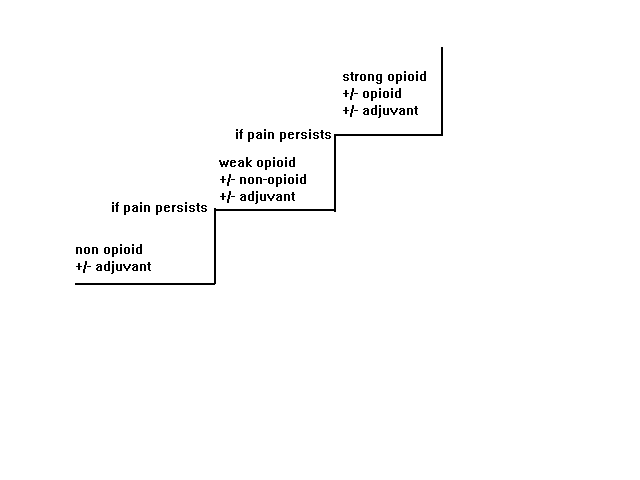
We use a stepped approach for selecting the appropriate analgesic.
This approach is modeled after the recommendations of the World Health Organization and other authorities.
Non-opioid (non-narcotic) analgesics
generally used to treat mild to moderate pain
ASA- acetylsalicylic acid
anti-inflammatory action - not as useful in treating bone pain as other NSAID's
anti-pyretic
analgesic
uricosuric
Mechanism of action- not exactly understood.
Thought to inhibit prostaglandin synthesis thereby exerting anti-inflammatory and anti-pyretic activity. May also have central subcortical action.
Well absorbed following oral dosing, metabolized by the liver and excreted in the urine.
Duration of action- varies depending on the formulation
available: reg tabs, EC tabs, supps
Major factors limiting its use are:
highly protein bound- potential for drug interactions
interferes with platelet function- bleed
allergic reactions- rash, anaphylaxis
Dose: 650 mg q4-6h for pain or fever
975 mg q6h for anti-inflammatory effect
Acetaminophen
On a milligram for milligram basis has same analgesic antipyretic potency as ASA.
Lacks anti-inflammatory and uricosuric properties.
Mechanism of action- peripheral, central, (minimal effect on prostaglandins)
Advantages over ASA: no gastrointestinal effect, does not affect platelets, virtually no drug interactions.
Concerns: chronic doses of greater than 2.6g daily may be hepato-toxic.
Presence of liver metastases rarely precludes its use in clinical practice.
Available: tablets, caplets, elixir, supp
Dose: 650 mg q4h. Maximum: 1000 mg q4h.
Frequently used in combination with weak opioids. (Tylenol with codeine)
Narcotic Analgesics
The narcotic analgesics are classified as narcotic agonists or narcotic antagonists depending on how they interact with the opioid receptors in the brain.
Agonists bind to receptors and activate it to produce analgesia and other effects.
Antagonists bind to receptors but do not activate them (Naloxone- Narcan)
The antagonists compete with the agonists for the same binding sites.
Some opioids have mixed agonist and antagonist properties.
Codeine:
a weak narcotic analgesic used for mild to moderate pain. It is metabolized to morphine which may partially explain how it exerts its effect.
It is mostly used in combination with acetaminophen (Tylenol #1, Tylenol #2 etc.) or with ASA (292's, 222's etc.). It can also be used as a cough suppressant but at doses lower than those required to produce analgesia.
Adverse effects limit the upper dose that we can use:
nausea, vomiting, constipation.
Available: tablets, elixir
Hydrocodone- weak analgesic, alternative to codeine but no advantage
Oxycodone- weak analgesic, used in combination with ASA or Acetaminophen. When used alone can be an alternative to morphine but dosing not as flexible as morphine.
Morphine- strong opioid
Morphine is the standard against which all other analgesics for terminal pain control are compared.
Used to control moderate to severe pain
Advantages: available in many different dosage forms and strengths:
oral solution, immediate release tablets, sustained release tablets and capsules, IM injection, SC injection, IV , intraspinal, rectal, can be administered via pump, has been used by nebulization.
Hydromorphone- Dilaudid
-5 times more potent than morphine
-indicated for moderate to severe pain
-not as flexible in dosing as morphine
-advantage over morphine is that it is more soluble so can give large doses in smaller volumes
Anileridine- Leritine
moderate pain
useful for patients who do not tolerate or have allergies to other narcotics
lacks dosing flexibility (25 mg tab, 25mg/mL inj)
ceiling dose 400 mg/day.
NOT RECOMMENDED NARCOTICS
Meperidine- Demerol
- short duration of action therefore require frequent dosing
- metabolite accumulate with repeated dosing leading to adverse effects which are sometimes difficult to distinguish from disease progression ( seizures, twitches)
- high incidence of hallucinations, disorientation
Propoxyphene (Darvon)
- efficacy questionable, may not be better than placebo
- interacts with antidepressants and anti anxiety drugs to produce hallucinations
- lacks dosing flexibility
- metabolites accumulate with repeated use
Pharmacokinetics of some narcotics
| Drug | Half life (hrs) | Duration of action (hrs) |
| Codeine | 3 | 4-6 |
| Morphine | 2-3.5 | 4-7 |
| Hydromorphone | 2-3 | 3-5 |
| Anileridine | 3-4 | 2-4 |
Adverse Effects
All narcotics will induce these
Constipation- most frequent, most troublesome, most persistent adverse effect
PREVENTION is the best cure. All prescriptions for regular use of narcotics should have order bowel care orders with them.
Nausea and Vomiting- usually seen upon initiation of narcotic therapy
caused by: a) direct stimulation of the chemo receptor trigger zone in the brain,
b) decrease in bowel motility
advisable to have anti-emetics ordered for prophylaxis
Sedation: occurs upon initiation of narcotics. Usually decreases after 3-5 days. What may sometimes appear as over sedation may be due to pain control which allows the patient to "catch up" on sleep. If persists, reduce dose, assess pain. May need to switch to another narcotic.
Dry Mouth: may be also due to dehydration, other concurrent medication, post chemotherapy. Watch for oral candidiasis.
Confusion: occurs in a small number of patients, particularly elderly. Need to differentiate from brain metastases. May need to reduce dose.
Small dose of Haldol may help.
Urinary Retention: uncommon but can occur. May be aggravated by other medications with anticholinergic properties.
Catheterization may be necessary.
Addiction: not a concern in the terminally ill
Regular dosing removes the psychological preoccupation with obtaining narcotic analgesic whereas PRN dosing increases it.
Respiratory Depression: Not usually seen in long term use patients. May occur if starting dose is too high, or dose increments are too rapid, or when the increments are too large. Patients with pre-existing respiratory problems or renal failure are at a predisposed risk. Other indicators of overdose will be present before respiratory depression presents.
Reversible with Naloxone.
The mainstay of pain control in palliative care is narcotic analgesics. Total reliance on them is however inappropriate and ineffective. To obtain and maintain effective pain control other adjunctive measures must be utilized. These adjunct therapies may be broadly categorized into two types:
I. Drug Adjuvants (other than analgesic) to assist pain relief along with analgesics.
II. Non-drug Adjuvants to assist pain relief along with analgesics.
If either is used alone without an analgesic it is considered as a specific pain relief measure, not an adjuvant. Within each category the agents may sometimes be used individually with an analgesic, and at other times in multiple and various combinations with analgesics.
NON - STEROIDAL ANTI - INFLAMMATORY DRUGS AND CORTICOSTEROIDS AS DRUG ADJUVANTS
NSAID's
As their name suggests, these agents are used primarily for their anti - inflammatory properties.
-They act in the periphery by inhibiting prostaglandins.
used in bone pain, some soft tissue pain, hepatomegaly , arthritic pain
- No one agent has proven more effective than another.
They differ in the prostaglandin they inhibit, therefor their effectiveness in any individual patient depends on the predominant prostaglandin.
- Use with caution in patients who have decreased renal function, since they may further decrease renal blood flow and glomerular filtration rate.
- Selection also depends on incidence of side effects, ease of compliance and cost.
Adverse effects are due primarily to inhibition of prostaglandin synthesis
- Gastrointestinal: nausea, vomiting, ulcerogenic
- Renal: most pronounced in patients who have prostaglandin dependent renal perfusion
- CNS: tinnitus, headaches, visual disturbances
- Hematologic: altered platelet aggregation
(phenylbutazone- irreversible aplastic anemia)
When an NSAID is discontinued because of intolerance, the dose of narcotic must be increased (as much as doubled) to achieve the same level of analgesia.
The following table compares some NSAID's in order of increasing incidence of adverse effects.
* indicates formulary drug at SPH
| Drug (common trade name) | Duration (hours) | Maximum daily dose (mg) |
| * Ibuprofen (Motrin) | 4-8 | 2400-3200 |
| Fenoprofen (Nalfon) | 4-6 | 3000 |
| * Ketoprofen (Orudis) EC, SR, Supp | 6-8 ( SR =200 mg once daily) | 300 |
| * Naproxen (Naprosyn) | 8-12 | 1250 |
| Tiaprofenic acid (Surgam) | 8-12 | 600 |
| Flurbiprofen (Ansaid) | 6-8 | 300 |
| * Diclofenac (Voltaren) SR, Supp | 6-8 (24 for SR) | 150 |
| * Sulindac (Clinoril) | 12 | 400 |
| Tolmetin (Tolectin) | 6-8 | 2000 |
| Diflunisal (Dolobid) | 8-12 | 1000 |
| Piroxicam (Feldene) | 12-24 | 40 |
| Mefenamic acid (Ponstan) | 6-8 | 1250 |
| Floctafenine (Idarac) | 6-8 | 1200 |
| * Indomethacin (Indocid) SR, Supp | 6-8 (12-24 for SR) | 200 |
Corticosteroids
The two agents used by Hospice Victoria are Prednisone and Dexamethasone. Dexamethasone is approximately 7 times more potent as an anti-inflammatory than Prednisone
These agents have specific and non-specific actions when used in the management of the terminally ill.
Non-specific actions:
(These are desirable side effects and not indications for prescribing)
- improve patient's mood
- improve patient's appetite
- improve energy level
Specific actions:
They decrease edema and inflammation which is often associated with a tumor. The edema and area of inflammation may even be larger than the tumor itself. By doing so they relieve the pressure on adjacent sensitive structures such as nervous tissue and periosteum.
As analgesic adjuvants we see them used in:
- inflammation associated with radiation/chemotherapy
- raised intracranial pressure
- nerve compression
- head and neck tumors
-intra pelvic tumors
-metastatic arthralgia
- severe bone pain non responsive to NSAID's.
Adverse Effects:
sodium retention, fluid retention, aggravation of CHF, muscle weakness, osteoporosis, gastrointestinal bleed, pancreatitis, abdominal distention, impaired wound healing, fragile skin, increased sweating, convulsions, endocrine disturbances, increased intra-ocular pressure and aggravation of glaucoma.
Since the long term prognosis of these patients is not positive, it is the short term adverse effects that concern us most.
Nearly all terminally ill patients treated with cortecosteroids will develop oral candidiasis.
Gastrointestinal bleed and GI upset are generally of concern, especially in those patients who are on concurrent NSAID's.
Aggravation of glaucoma and CHF.